Miss Piggy’s Big Number

My knees bear testament to my clumsiness. They both carry faded yet visible remnants of an epic netball game played in Johannesburg in 1991. We lost. Fifty-zero. I don’t think I was the worst player on the team. Just the clumsiest.

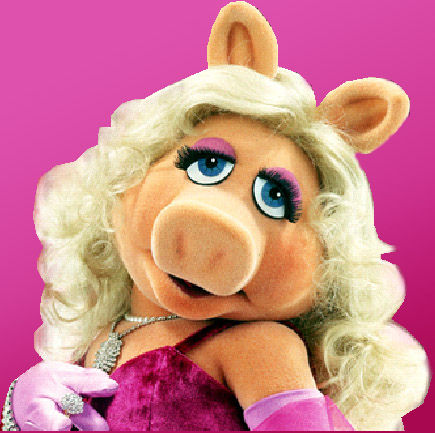
Miss Piggy is not clumsy. She is gorgeous and graceful in all her Miss Piggy-ness. And everything she does – from blowing Kermy a kiss to performing on stage – is a Big Number.

woolymammothblog.com

woolymammothblog.com

But me… twisted ankles always. Graceless runner. Bumped elbows and bruised hips still, as I move too quickly, thoughtlessly. I went flying on that tarmac-covered netball court decades ago, bruised and scraped my knees so badly my husband will tell you it’s the first thing he noticed about me when he met me a year later. No athletic ability at all. Just clumsy.

A few summers ago, my family discovered the magic of Lake Berryessa in Napa County, California. The most incredible lake I’ve ever seen. Enormous and blue with high ochre-colored banks and tall trees. Mirror-smooth water. The air is hot and dry, the water refreshingly perfect when you first dive in, just enough chill to keep you giggling and happy.

berryessa

We rented a speedboat, skis, and an inner tube. The kids tubed for hours, faster and slower, we tried to get them to fall off. The laughter bubbled out of their bodies.

kids_tube

And then I decided it was time for my Big Number.

No athletic ability. As clumsy as anything. But I can waterski. I can engage my arms, and weight my thighs, somehow balance on my wobbly angles and actually stay upright for as long as I want. I can glide over that water, cross the wake, and feel faint whispers of (dare I say it) graceful ability.

My uncle taught me how to waterski. At the Vaal River in South Africa – a long, wide, gently flowing river that separates Gauteng province from the Free State. Beautiful weeping willow trees drape the riverbanks and lazy leguaans (a type of lizard) float in the water. It’s one of the most serene, tranquil places I know. And where some of my most favorite childhood memories live: swimming, barbecues, swinging from a rope off the jetty. Long lazy Sundays of laughter and togetherness.

The last time I skied at the Vaal must have been around the time I scarred my knees. It was 20 years before I skied again. Before my Big Number.

Shivering with anticipation and nervousness, I held the rope tight. The boat moved, I lurched and for a second I envisioned a belly-flop. But I tightened my arms, leaned back… and I was skiing! Whispers of graceful ability.

I breathed in the dry California air, crossed the wake, felt the chill spray in my face, and heard my kids’ happy, whooping disbelief that their mom knows how to waterski.

My childhood memories of fun and happiness, of a gentle, patient teacher with the biggest laugh in the world, propel me up and forward on that water. My Big Number.

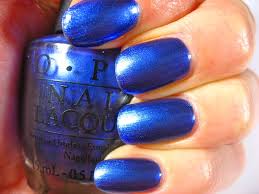
Miss Piggy's Big Number by OPI

Miss Piggy’s Big Number by OPI

This post was written as part of the April A to Z Challenge. To read more of my A to Z posts click here.


This is 40?

I was always the youngest. Not at home, at home I was the oldest. But everywhere else I was usually the youngest. The youngest in my grade. The youngest in my ballet or drama class. Because I have the southern hemisphere equivalent of a fall birthday – mid-May.

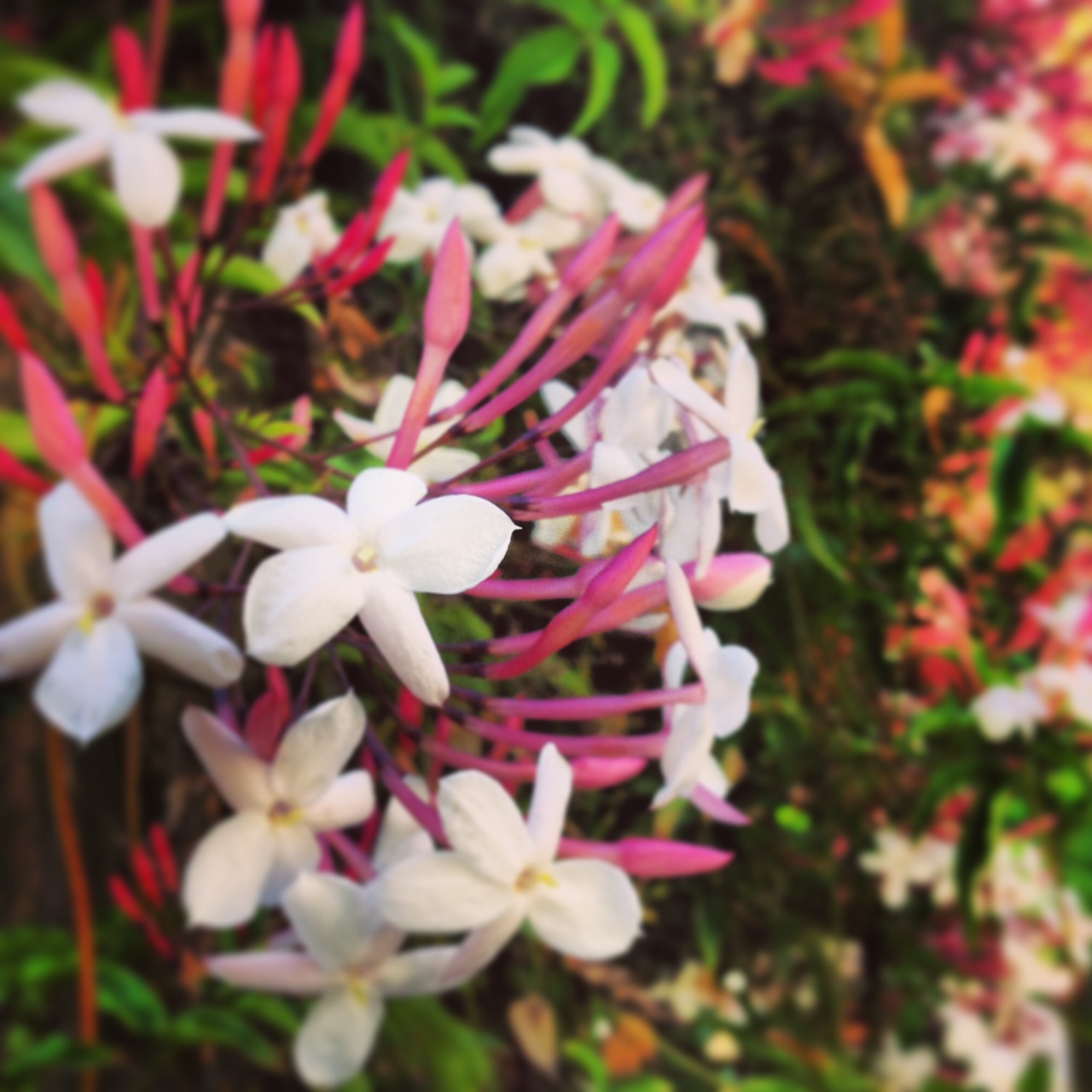
jasmine1And half a world and many decades away, where the seasons are turned upside down, and where my birthday is now in the spring, I am still the youngest.

My 40th birthday is two months away. Thanks to a severe drought and global warming, spring has already sprung in Northern California. So it’ll be early summer by then. The fragrant jasmine will have wilted on their stems, leaving little more than the faintest heady whiff in the breeze.

For a while I was “never turning 40.” As friend after friend – some with two to four kids of their own, and companies to run, with aging parents and mortgages and expiring car leases – made it ‘over the hill’, turned 41 or 43 or 47, I was still in my thirties. In the same pick-up line as they were, rushing kids to ERs just like they were, signing tax returns and home loans and sometimes feeling older than even my older friends whose kids were a few years younger than mine, or who didn’t want to get married just yet.

Almost 40. With responsibilities and people, both big and little, and deadlines and obligations and appointments and a full life of color behind me, and a big blue something ahead… but I’m not excited. I’m scared. Confused. So unsure. So not confident. I wish I was 24. When I knew myself better.

Of course, hindsight is always crisply clear – the view of myself as the self-confident, sure-of-herself young woman starting her life on the foggy hills of San Francisco as Mrs Gilbert is vivid and bright, while the vision of ageing, graying me finally moving to Israel once all my kids are grown is hazy and almost impossible to see. Not just because it’s the future, and who knows what the future holds, but because… is that what I really want to do? Do I want to leave all my kids behind and move to another country without them? Yes. No. Maybe. I don’t know. If I stop being a stay-at-home mom now, will I regret it in ten years when they’ve all left (actually it’s 13 years, but who’s counting)? Do I want to write, or act, or teach, or own a boutique or work in a bookstore or WHAT?

I am 60-something days away from the fabulous-not-so-fabulous four oh. Confused. Confuzzled (my mother’s word). Just mixed up.

On a rare rainy day in Sonoma last week, after I declared to my best girlfriends that I knew myself better when I was in my twenties than I do now, I realized that’s not quite true. Or rather, they helped me realize it’s not true. That what I was in my seemingly cool, calm and collected twenties was blissfully oblivious… to me. And I started thinking about the things I do know:

  • I know that I don’t know. I know that I am confuzzled. I may be less self-assured, less self-confident than ever before – but I have heaps of self-awareness. And then some. Enough to drive me even crazier than I am now, before I make it to 50. Or even 45. Gulp.
  • I know that it’s more than okay to say “no”. Not to alcohol. Or to cupcakes. But to commitments. To volunteering. To having someone else’s kid over. To attending an event. To anything that is something I do not want to do. Or that will take me away from doing something I really do want to do. People understand. In fact, I think they wish they had said no too.
  • That sometimes my “greatest accomplishment of the day is making my bed.” This is something my close friend L always says – she is five years calmer, wiser and older than me. She reminds me that I don’t have to do it all – actually, I don’t have to do any. That the all or the nothing is overwhelming, but it doesn’t have to be that way. And damn, she’s right about the bed: it does feel all kinds of good to yank those sheets straight, and tuck the loose ends under.
  • I know that I love meat. And marrow bones.
  • To cry is to feel. And that is wonderful. I used to keep my tears in, because I didn’t want to face the emotional hot mess they left in their wake. But I’ve discovered how awesome tears are – the relief and release to not have to keep it all together. To feel whenever I want. Even wherever I want. Like in my workout class. Or in the car. Sadness and joy and love and fear and songs and memories.
  • I don’t get hangovers. Obviously I’m not drinking enough. Goal for my forties: wake up with a hangover.
  • There’s never an excuse for bad manners. Say hello. Say goodbye. Say please and thank you. Always. Whether you’re four, or 14 or 57. Do not get out my car and slam the door without saying, “Thanks for the ride.” Wish the barmitzvah boy and his parents mazal tov, and if you want something from me, please say please! Manners make people nice people, manners maketh the mensch.
  • Accept apologies – they are heartfelt, even if they don’t sound like they are.
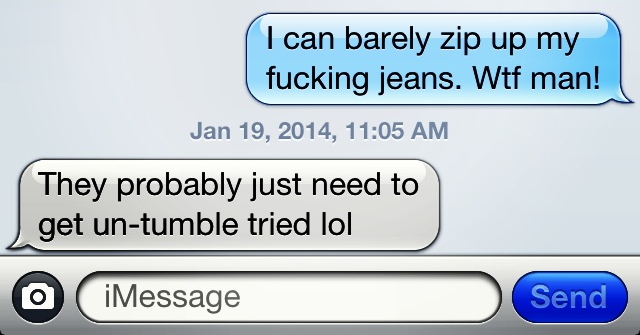
  • Skinny jeans can ruin my day as I lie on the floor or wriggle my hips trying to zip them up – they did fit last week. But my sister, and sometimes my brother, saves the day (and this is true for much in my life):

jeans

  • Finally, no matter what artistic brilliance, technologically advanced special effects, incredible animation, outstanding acting, writing or directing we have enjoyed over the last three decades the very best movies are, and always will be, Eighties Movies: Ferris Bueller’s Day Off, The Breakfast Club, Moonstruck, Indiana Jones, Say Anything. Don’t you order what she’s having? Do you ever put Baby in a corner? Who doesn’t love to cut loose with Kevin and Kenny? Best. Movies. Ever.

I am the last of my friends to turn 40. I’m the youngest. And I feel more confused now than at any other time in my life. Blissfully oblivious, like I was in my twenties, sounds kinda appealing, I admit. But oblivious is really just oblivious – I’m not sure it’s blissful at all.

I’ll take marrow bones, Maverick and no hangover for now.

marrowbones

I wish I knew what she was thinking

That blank stare.

I never knew if she was happy, angry, sad, pissed off at me, or maybe not understanding my fast, accented English. Was it not okay that I dumped the groceries in the kitchen and then dashed out again? Should I not have asked her to clean the pantry if she has time? I just never knew what she was thinking.

Hard to get an emotional read on an already sensitive situation: employer-employee, woman to woman, have versus have-not.

I am sensitive to it because of how I grew up, with housekeepers and gardeners. Somebody to make breakfast and wash the dishes, unpack the groceries, do the laundry, water the garden, feed the dog, keep the bathrooms clean and the house tidy. That was how most white South Africans grew up. Somebody to babysit us when my parents went out, or for my little brother to stay with when my mom watched me and my sister at ballet recitals and drama festivals. Somebody, or two somebodies, to help. They made our beds, played with us. Because our parents worked and also because they didn’t. I know many Americans and Mexicans and Brits and Israelis and Brazilians who grew up the same way. With hired help.

It’s the way of the world in certain countries and in specific socio-economic communities – those that can and have and need to and want to employ those that will and have not. Employer-employee. It works like that.

Except of course, it’s not so simple. It’s not just employer-employee. It’s a system laden with undercurrents of guilt, with feelings of superiority and inferiority, of not wanting to offend or insult but still wanting the job done right, of wanting to do the job right but feeling unsure or insecure.

I’m sensitive to it because now I’m a part of it. Now I am navigating this complex emotionally fraught system. Equal parts expectation, responsibility, guilt and gratitude.

She came to work for us seven years ago, when my daughter was four months old. With barely any English at first, she quickly became indispensible to me. I hadn’t had consistent help before, and it was a relief to be able to leave this child asleep in her bed, and not in her car seat, while I drove a carpool. To go to Target unaccompanied. To have all the laundry washed, dried, folded and put away before noon, and by someone else. To come home to a house smelling of Pine Sol and orange floor cleaner. To have an extra pair of hands on deck when one was blowing bubbles in the bathtub and one was about to hurl herself down the stairs, while yet another was making a beeline for the dog food.

But if I spoke too quickly, if I told her not to take the baby to the park, if I asked her to stay late or leave early or do it a different way, she would look at me, with no expression in her face. “Shit,” I thought. “Is she mad at me? Did I say something wrong? Something offensive?” I hated to think that she felt silent or silenced, that she couldn’t tell me what she really felt or thought. Or that G-d forbid she didn’t love me all the time. That she wasn’t happy.

I was uncomfortable in this role, as employer of this woman – not much younger than me – who was taking care of my children and cleaning my house, putting away my underwear, hearing my arguments with my husband, throwing birthday parties in the park for my babies at her own expense. Birthday parties with piñatas and carefree fun and Spanish songs and laughter. The birthday parties they remember in living color.

wendy

This woman, who had left her parents and her seven brothers and sisters and her home in Guatemala at the age of 22, and walked across Mexico for eight days and nights in harrowing conditions until she somehow made her way to Oakland and to me. Mercifully unscathed on the outside, but what about the inside?

I had left my country and my family too. But that was the only similarity between us. I was uncomfortable with what I had and what she didn’t. Citizenship. Financial resources. Language. Her parents would travel hours to her brother’s house just to Skype with her – mine flew across time zones to visit me in the flesh. And I could go to South Africa, or Guatemala, or anywhere in the world whenever I wanted.

Did she begrudge me? Did I act spoilt? Ungrateful? Was that the blank stare?

After seven years of taking care of me, of loving my babies, chopping my vegetables, making my bed, speaking my language, spending time with my parents, her longing to go home was burning so strongly in her heart, I could feel it across the kitchen counter.

So she did.

Her return journey to me was one of unknown peril and fear and angst. Eight months of collect calls. Of tears and worry. She said she was fine. Treated well. They would let her in, she was sure of it. But I could hear the doubt in her voice. I could feel the regret in her heart. I wasn’t sure we would ever see her again.

Yesterday was her birthday. She turned 32. Her first day back at work. In my house.

“Are you okay?” I asked.

“Yes,” she said, her eyes blank.

“Really?” I pressed.

She continued folding one of the boys’ t-shirts. And with no expression in her face, or her voice, her dark eyes looked honestly into my green ones:

“I’m happy. This, your house, is my second house. My home.”

Remembering Madiba

I couldn’t take my eyes off the blonde woman in the pink sweater, as she swayed to and fro with a tender smile on her face, singing to the cute little black girl she held in her arms. In the midst of a huge crowd, she was oblivious to the cameras as she sang, “Nelson Mandela, Nelson Mandela” in tribute to one of the greatest human beings our world has ever seen.

This was CNN’s coverage, live from Johannesburg, South Africa on Thursday, December 5, minutes after the announcement that the beloved leader had passed. At 1am South Africa time, while my father-in-law drove to Mandela’s home and joined the crowds gathered to celebrate this exceptional man, I was watching from the floor of my bedroom, thousands of miles away in California.

And as I continued to watch CNN over the next few days, and read the tweets from media in the US, South Africa, Israel, as I refreshed my Facebook feed and liked friends’ status updates when they changed their profile pictures to smiling faces of Madiba, paid him their respects, shared their favorite Mandela quotes and tribute videos, I realized how far away from South Africa, from Mandela’s South Africa, I really was.

I think of myself as a small-town girl, from Pretoria. In truth, Pretoria is a big city. Thirty miles north of Johannesburg, it’s the national capital, home to the Union Buildings where presidents, including Mandela, are inaugurated and where most government business is conducted. A couple million people live in Pretoria. It has its own university – the University of Pretoria – and its own rugby team – the Blue Bulls. Theaters, schools, shopping centers, restaurants, green leafy suburbs, a bustling central business district, hospitals. There is nothing small-town about it.

Except in the way I grew up – white, Jewish, privileged, sheltered.

My world – and the world of most of the Jewish families living in Pretoria in the eighties – was limited both physically and socially to the suburbs surrounding our Jewish day school and synagogue, with weekend drives to nearby Johannesburg and the Vaal River. Pretty small-town.

Pretoria’s Jewish community was, and still is, largely comprised of anti-apartheid Jews, many of whom were the children and grandchildren of Holocaust and World War 2 survivors – if not survivors themselves – who had emigrated to South Africa from Lithuania, Russia, Germany, Poland. Well-versed in what it means to be discriminated against, oppressed, hated. They were not supportive of a government that perpetuated the same abhorrent schisms.

Fewer Jews settled in Pretoria than in Jo’burg, and the community I grew up in was tight-knit and protective. Seen through my young eyes, it was idyllic despite the apartheid happening around me.

Most white kids growing up in South Africa in the eighties understood apartheid – perhaps not in detail, but we all had a strong sense of the segregation, discrimination and oppression happening around us. It was a part of our lives: our housekeepers were mandated to carry identity passbooks with them wherever they went – if they were questioned by police and didn’t have their passbook they were arrested. There were green buses for white people and red buses for black people. Park benches and public toilets had signs bolted on: “Net Blanke – Only Whites” (in Afrikaans and English, not in any other language). The economic and social divide between blacks and whites was enormous, gaping, seemingly unbridgeable.

Some of us knew better than others who Nelson Mandela was, and why he had been in prison on Robben Island for over two decades. For me, a fifth grader in a small Jewish day school in Pretoria, Mandela represented all those millions of people who didn’t have what I had, who couldn’t do what I could. But to my sheltered, young self he was elusive, a name and a face standing for the struggle of the oppressed.

As I moved through high school, the more mature me began to properly understand the tension of the country we were living in. While I’d never known anything other than apartheid, I started to long for the injustice to end. F.W. De Klerk was now president and with the dawn of a new decade, Nelson Mandela was released.

My sheltered world opened up a little. Our high school drama club staged an award-winning play written by our English teacher called The Non-Musical Human Rights Take it or Leave it Children-of-the-Rainbow Part 2. It poignantly tackled themes of censorship, oppression, human rights and ultimately the creation of a “Rainbow Nation.” I was 15-years-old – I had never really thought about any of this before, even though it was what I grew up with.

The arts in South Africa vibrantly exploded when Mandela walked free. The Rainbow Nation he was creating found true expression in living color on stage, in writings, TV, paintings, comedy shows, music – all reflecting the euphoria we could feel in the land. It was a time of hope and possibility. Mandela’s smiling face was everywhere – he amazingly harbored no grudge, no blame, he was committed to moving forward, to replacing the hate and segregation with love and reconciliation. That gaping divide was already smaller.

I was in my final year of university when I voted in South Africa’s first democratic election. I stood in line with my sister outside the Great Hall at Rhodes University, together with all the men and women that cleaned and maintained those beautiful old buildings, that cooked for us and joked with us when they served our food, or swept out the lecture halls after class. I can’t even begin to imagine what they thought and felt about finally having basic human rights returned to them, but I was overwhelmed with gratitude that it was happening, and that I was there.

Madiba-at-Rugby-World-Cup-1995

leavenogirlbehind.org

My most vivid memory of a unified, free South Africa is watching the Springboks win the rugby world cup in 1995. Nothing short of spectacular! For me, that victory epitomized what Madiba had achieved for the country – using a national sport historically played by white Afrikaners, loved by the very people who tried to keep him silent and locked away, to build a bridge across a gaping divide. Mandela wearing the Springbok colors of green and gold with that smile that lights up the world is a powerful reminder of his belief that if people can learn to hate “they can be taught to love, for love comes more naturally to the human heart than its opposite.”

I never really lived in Mandela’s South Africa. I left four years after that election. I was barely a part of the rainbow nation. I sit in my car outside the supermarket in Oakland, watching the Soweto Choir in Woolworths sing the sweetest, most moving tribute to their Tata Madiba, on YouTube, with tears in my eyes and a smile on my face, and I feel very, very far away.

My daughter takes the photograph of her father shaking Mandela’s hand up to her room, just to look at it for a little while. And even though I am far away, I am South African, and I am humbled by the magnitude of the legacy of this tremendous human being, and so grateful for his tireless struggle for a better, equal life for all South Africans and for humankind.

“For to be free is not merely to cast off one’s chains, but to live in a way that respects and enhances the freedom of others.” -Nelson Mandela, The Long Walk to Freedom
Totally Californian… essentially South African

Summer rain. I miss it. The clouds scurry in – gray and heavy. The temperature drops, but only a little. Fat droplets start to fall, one at a time, and within minutes it’s raining loudly. It’s rain with a purpose. Not gentle and misty, not dreary and relentless. Thirst quenching, life-giving, happy and warm. Almost as quickly as it begins, it’s over.

Clear skies and sticky air. The trees are bright, and the birds are loud. Water drips from the leaves onto the tiled walkway. And the intoxicating fragrance of magnolia is suddenly everywhere.

I was disoriented. For a moment I was back in Pretoria, South Africa – where it rains, like this, almost every afternoon in early summer. Growing up, I would stand at the open front door, watching and waiting. Loving the steady sound of the rain on the roof and the windows. Knowing it would stop soon, the sun would come out in moments, the birds would start to call and I would breathe in that heady magnolia. Africa.

But this was Australia!

As the confused clouds blew across my brain, my heart contracted with longing. The smells and sounds coalesced into a blanket of nostalgia, lightly draping my shoulders.

Sydney

Sydney, Australia is a beautiful, fun, happy city – home to the Sydney Opera House, the Harbor Bridge, magnificent water views wherever you look, cuddly koalas and fierce-looking kangaroos. Absolutely worth the 14-hour flight and crazy time change, kids in tow. It has an incredibly efficient ferry system, an amazing zoo, gorgeous parks and breathtaking beaches.

And a layer of “South African-ness” I was not expecting. Which left me surprisingly homesick.

Of course, I know that many South Africans have made Sydney their home – it made our trip even more special to spend time with old friends from elementary school and college while we were there, reconnecting, reminiscing, introducing our kids to one another.

What took me by surprise was how familiar the city felt to me. In the southern hemisphere. Chanukah in summer. Houses built from brick not sheetrock, and neighborhoods reminiscent of Johannesburg in their layout. Even the ocean felt more Indian than Pacific! Nobody asked where I was from – in California sometimes my accent sounds Australian… or Irish… or British. In Australia it’s clearly South African.

And because there is such a large South African community, typical South African foods are easily available, foods that define many of my childhood memories, and that my American children now love: biltong (puts beef jerky to shame – there is no comparison), boerewors (delicious sausage, the flavor can only be created by South Africans), chocolates, cookies and Joko tea, Nando’s Chicken (a franchise imported all the way from Johannesburg to Sydney, London, Washington DC – but sadly not San Francisco). If you know South Africans living outside of South Africa, you know how much we crave our SA food!

At the “South African shop” in Rose Bay, the owner recognized our last name – he knows my father-in-law – and the manager’s daughter went to high school with my husband. The couple staying in the apartment next door to us felt as familiar to me as my own aunt and uncle – even though I was meeting them for the first time! They hugged me when they met me, and kissed my kids, and for a minute I thought maybe I had known them somewhere before. But it was enough that we were Jewish South Africans for all of us to feel connected. She was making chopped liver for Shabbat dinner, and he cracked the same kind of jokes my dad does, and they used slang South African words we hadn’t heard in so long… and the longing squeezed my heart again. Homesick.

But I’ve lived in the Bay Area for 15 years. We left six weeks after our wedding, and my children are Californian. They have American accents, they like beef jerky and they think a costume is what you wear on Purim or Halloween (it is, but in South Africa it’s also your bathing suit). When I think “home” I see the Bay Bridge, not the telecom tower I rode my bike to as a child in Pretoria.

As we enjoyed our week in Sydney, swimming in waves that felt like those in Durban, having braais (barbecues) with old friends, waiting out the afternoon rain, those confused clouds continued to scurry across my mind.

Back home in the Bay Area, my friends understand when I reply ya instead of yes, I have found the best boerewors from a kosher South African butcher in Atlanta (they ship it next-day on dry ice!), and we have braais as often as we can. It rains in winter – sometimes incessantly – but during spring and summer I can smell magnolia and jasmine all over.

am South Africa homesick… but in the Bay Area, I am home.

Sydney, Australia November 2013

Sydney, Australia
November 2013