What I Never Imagined…

BoysWall

We came to Israel this summer to celebrate.

And for many other reasons too: because our kids had never been and we wanted to show them the land of their people, because we love beach vacations and no matter where you are in Israel you’re seldom further than an hour from an incredible beach, because the food is amazing (never mind the shwarma and falafel, even frozen schnitzel and french fries are delicious here – especially if you eat them on the beach!), because you can kayak down the Jordan river and ride a wobbly camel in the Judaean desert, buy fragrant spices and the freshest challah at the bustling Middle Eastern market in Jerusalem and find the most exquisite shoes at the beautiful mall just steps away, because Israel grabs you by all five of your senses and never lets go…

But mainly we came to celebrate my oldest son’s bar mitzvah. He’s been practicing his Torah portion for almost a year. I’ve heard him once or twice – he doesn’t falter, never hesitates. He has spent hours with our rabbi in Oakland learning, discussing, preparing his speech and his words of Torah.

I imagined it. South African grandparents, and aunts, uncles, cousins from Herzliya, London, Florida, Johannesburg, California, friends from Oakland and Jerusalem and Tel Aviv. I imagined the praying and Mazal Tov! and brunch overlooking the Old City. Shabbat dinner and then a party in Jaffa, while the sun sets into the Mediterranean and we dance and laugh and celebrate.

I imagined us all together, a gigantic family barbecue on the beach, introducing my sister to my future sister-in-law, listening to all the brothers reconnect, meeting my friends at my favorite rooftop bar in Jerusalem. I imagined tears of pride and joy and relief, laughter and singing and so many hugs and kisses on both cheeks.

But I never imagined this.

Of course. I never imagined we would celebrate during a war. I never imagined I would take shelter from an air strike in a restaurant kitchen. Or in my cousin’s house, together with his neighbors and their kids because they don’t have a bomb shelter. I never imagined my kids would know what to do when they heard a siren – but they do, and they don’t falter, never hesitate. I never imagined it was possible to receive so many messages of worry and love from every corner of the earth, every day and through the night. I never imagined I maybe wouldn’t meet my friends to watch the sun sink over the Old City, because who in their right mind would fly into a country during a potential war?

And I never imagined I would almost forget we came to Israel to celebrate my oldest son’s bar mitzvah.

Relentless rockets have been fired into Israel for seven days. Sirens wail from north to south, east to west throughout the day and long into the night. Thank G-d for those sirens, alerting every living creature to take cover, find shelter, usually within 90 seconds but sometimes less. Turn off the car if you’re driving. Move away from it quickly. Find a wall facing north or lie flat on the ground. If there’s no bomb shelter in your building, stand under the stairwell. Listen for the boom, the interception, the all clear.

Finish the surgery on the dog. Continue the soccer game in the backyard. Pay for the sunglasses, and don’t forget the tomatoes. Dinner is almost ready. Life continues.

Who could’ve imagined this? Not I, dreaming my perfect party dreams in my house in California. Not my son, singing his Torah portion over and over with the rabbi at our Oakland synagogue in preparation for his big day at the Kotel. And not our family and friends living their lives in cities and towns all over Israel, planning the summer for their children, taking care of their elderly parents, scheduling appointments and meetings.

Life continues during a war. Or maybe it continues especially during a war.

I could never have imagined we would be in Israel this summer in the midst of an almost-war. But I cannot imagine being anywhere else. Israel grabbed hold of me and every single one of my senses while I was on a family vacation 30 years ago, and has never let me go. Being here while she is under siege, while so much of the world is turning its back on her and its people, only strengthens that grip. She has never let me go, and I will never let her go.

Life continues, especially during a war. And we are here to celebrate my oldest son’s bar mitzvah. Mazal Tov!
Life in a Bubble

JedMikhmoretThe sun glittered on the reckless Mediterranean. Not quite afternoon, not quite sunset. The golden time in between, when the beach shines almost white and the water is a liquid glow.

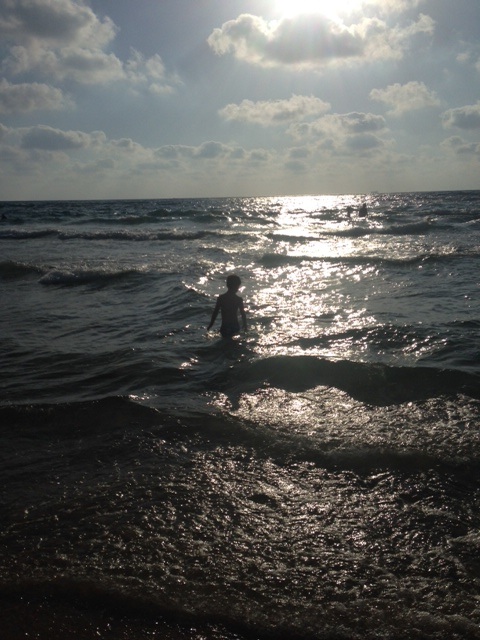
Not so gently, the sea knocked them over first from one side then the other, occasionally pausing its playful game so they could catch their breath and float in the warm water. With the sun making its slow descent, they were smiling faceless heads of all ages, talking, laughing, diving right into the crashing waves or holding the little ones up high.

The smoky barbecue drifted toward me as I helped my daughter and her cousin build sandcastles. No English for her and no Hebrew for her, they built a beautiful, sandy city together with nods and smiles, gestures and touches. Up ahead three horses carried their riders toward the dunes. The sun sank lower.

The boys played Frisbee. The girls built their castles. The grown-ups drank beer and sparkling red wine, and the dog lay in the cooling sand, watching and sleeping.

They were photo-perfect moments happening every second, and my cousin ran from group to group and captured each one. “Chayim babu’ah,” she said. Life in a bubble.

Because while we were celebrating birthdays and family and togetherness on my favorite beach in Mikhmoret, sirens were wailing in Herzliya and Holon, rockets from Gaza were hurtling toward Tel Aviv and Jerusalem, and even with scarce cell reception on the beach we all knew.

I saw my aunt’s jaw tighten, almost imperceptibly, as she listened to her chatty granddaughter tell a story. One cousin sat quietly on a chair to the side, minding her own stressful business while she decided whether to cancel the 200-person event she’d planned down south the next day or to go ahead. Another calmly showed me a photo she’d just received of a rocket exploding above her house, a wry smile tugged at her mouth and the worry in her eyes was deep and real. Her feisty little girl toddled toward the sea.

The sun set, and the sky was orange and gray and crimson and the palest, whitest blue.

Life in a bubble.

We sang happy birthday, the kids played checkers and my uncle lit a cigar. I gathered up the half-eaten burgers and empty beer bottles, wiped the hummus with a crumpled napkin, and gave my son his fourth piece of chocolate cake. The music got softer. The sea was dark. “Can we stay till the end of the party, Mom?”

In my bag my cell phone silently rang itself into a frenzy. Dozens of missed calls and texts, emails and Facebook messages. “Are you guys ok?” “Where are you?” From South Africa, the U.S., England. And Israel. Family worried about us. Friends unable to get hold of us.

There’s no wi-fi on the beach in Mikhmoret and I forgot about my cell phone buried in my bag on the bench behind the barbecue.

Life in a bubble.

We didn’t hear the sirens on the beach, we didn’t see the Iron Dome intercept some rockets or hear the boom of the ones that fell. We were celebrating life and watching new friendships transcend language and running after toddlers lured by the playful sea. Because that’s what we planned to do that evening.

“We’re fine,” I texted back. “We were on the beach. Sorry I didn’t hear my phone. We’re okay.”

“Stay safe,” the messages came back, over and over. How do we do that, I wondered.

Life goes on here, as rockets are flying and strikes continue. My kids pet bunnies and ride horses bareback, but it’s impossible to keep them oblivious when we are shown where the bomb shelter is in our apartment building, and my husband explains how to pump the air once we’re sealed inside. We still haven’t heard a siren, thank G-d. But we may today, when we go up to the Kinneret or perhaps to the Dead Sea or maybe we’ll just stay put.

Ma la’asot?” our family on the Kibbutz say, when we visit them and watch the kids swim in the pool. We have schnitzel and salad and delicious ice cream for lunch. What to do? Life goes on.

My aunt calls to check on us. My husband’s family here is worried about us. Because we are visiting. And we’re not used to this. And it’s tense and complicated and scary.

But I’m not scared. We’re supposed to be here.

A bubble with a flimsy, transparent barrier. A bubble that is real and blissful but fleeting and temporary. Anything can happen at any time. And we pray that it won’t. We pray that there will be no more conflict. No more strikes and no more retaliations. No more children killed. We pray for each other, and for our land, and for peace.

It’s scary – but I’m not scared.

And in a fragile, clear bubble, life goes on.

First Five Days, Top Five Moments

Our arrival in Israel five days ago was underwhelming. And I was disappointed. My kids were tired, hungry, irritable. I was emotional.

In less than two days we had departed the foggy coast of the Pacific, crossed the Atlantic, flown over the Baltic and Black Seas, and landed on the too-sunny shores of the glittering Mediterranean. We had been awake since 3am Swedish time, which feels like bright midday all the way there up north where the sun barely sets, and were too many confused time zones away to figure out if it was dinner or breakfast or just a glass of apple juice we wanted. Or all of those. Or really just the bathroom.

But we had landed in Israel! Rally children, rally! Be excited! The place your mother calls home. Where she longs to live with you and your dad and Pretzel the dachshund, to speak Hebrew, and eat spongy pita with real hummus and those vanilla “Dani” puddings that only taste good here. Where the scent of the orange blossoms in the hot, middle-eastern air envelopes me in a nostalgic hug of sunny memories, and even the impatient bus driver who almost ran you all over with his hands in the air and not on the wheel makes me smile fondly.

But their initial response to the homeland of my dreams was muted.

It was hot. They were tired.

I wiped the tears of too-much-to-explain from my beaming cheeks, quietly listened to the song in my heart, and gently herded them through the bustle of Ben Gurion airport – only to be faced with an unmoving wall of humanity at passport control. Apparently every flight from Europe lands in Tel Aviv at the same time. Balagan. Chaos.

My wily, street-smart second boy deduced the only way to get us through this mass was to start a line of his own. And so began a series of unforgettable, and definitely unmuted, moments… and it’s only day five:

  1. “Who needs Google translate when we have Mom,” remarked same, streetwise son as I negotiated our way through the parking lot on our jetlagged, 11.30pm supermarket run that first day. My children had never heard me speak Hebrew, complete with pseudo-Israeli accent, and I think they were (mildly) impressed. That moment is up there with the time they discovered I could water-ski.
  2. My five-year-old handful of a boy, who announces every time his beach-loving family is within half a mile of an ocean that he hates the beach, cannot get enough of the Mediterranean waters and languishes in the sand on its shores. Maybe because it’s warm. Or maybe because it’s not an ocean, it’s a sea. Or maybe because it’s Israel.
  3. “Did you say thank you?” I nag at my shy daughter, as the waitress places her drink in front of her. There is no excuse for bad manners in my book. I don’t care how shy or tongue-tied they are – please and thank you always, no matter what. She looks straight at me, such sincerity in her big, green-gray eyes. “I did Mom, I said todah.” Oh. Not just “thank you.” Thank you in Hebrew. That shut me up fast.
  4. More Hebrew from my oldest who has started calling me Ima (Mom), greets us with a cheery boker tov (good morning), and orders mitz anavim (grape juice) for himself and his brother. My kids go to a public school in the U.S. and do not learn Hebrew on a daily basis like my husband and I did growing up, so to hear them use this important language of their heritage makes my heart sing with pride, joy and relief. They get it.
  5. Israelis are friendly – they want to know where we’re from, why we’re here, what we are doing. And when we tell them we’re celebrating the big one’s bar mitzvah, their delight is palpable. Whether on the beach, at the Western Wall or the spice stand in the market, they are full of good wishes for the bar mitzvah boy. Mazal Tov they yell, high-five him and shake his hand. It’s awesome. He is glowing. And growing – I think he is now taller than his mom, just in time for his bar mitzvah.

Our arrival may have been muted and underwhelming. But it didn’t take long before we were living each day in this hot, energetic, frustrating, wonderful place in full color, complete with noisy language and hand gestures. And it’s only day five.

There is family to meet (“You have too many cousins, Mom,” they grumble good-naturedly as they try to keep the branches of the family tree stick-straight in their minds), history to learn, and their entire religious and cultural heritage behind and before them.

For 13 years I have dreamed of showing my kids this place that I call home.

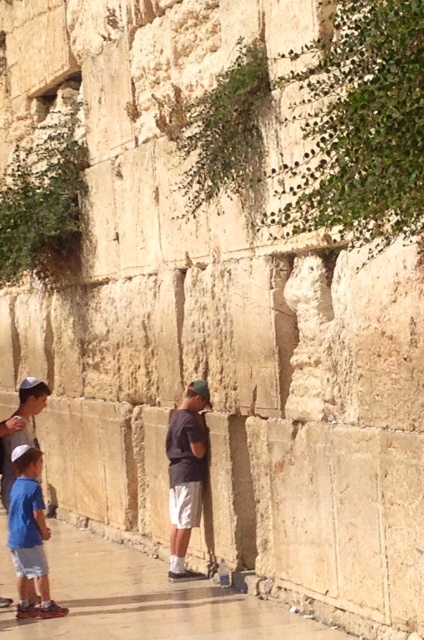
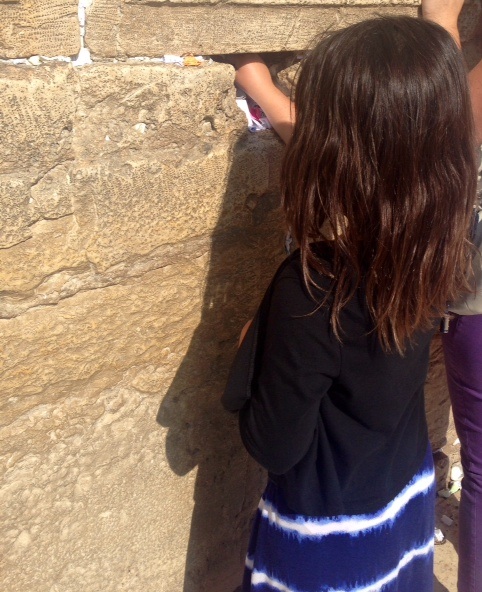
They each tear a page out of my notebook, and write notes of prayer and wish to place in the cracks between the gigantically smooth stones of the Kotel (Western Wall) in Jerusalem.

sageWall

I watch my daughter and sons look up at those enormous stones. I wonder what they are praying for, what they are dreaming.

I am overwhelmed. And it’s only day five.

May Her Memory Be a Blessing

rainbow

Death can be a funny thing.

I don’t mean funny ha-ha. I mean funny strange. Peculiar. Complicated. Sad. Or not. Relief. Indifference.

When we lose someone significant from our lives the rainbow of feelings may span a sky as vast as a lifetime – dark and stormy, light and airy, angry red, bluest blues, nostalgia, memories, regret, peace. Everything at once or nothing at all.

All four of my grandparents passed away when I was old enough to remember them, and their passing. I was eight, then 13, 25, 36. I had a special relationship with each, but was closest to my Granny Mary who died six weeks after my youngest was born. Granny was a real baby whisperer – adored infants, loved to hold them, to feed them, change them, burp them, to rock and sing to them for hours – but she never got to whisper to my littlest guy. He has no tangible memories of her and no photographs with her to trigger any.

Losing all those grandparents was devastating. Some were expected – one grandfather had Parkinson’s and was 81 when he died, both grandmothers were clearly near the end of their lives – but my gruff Grampa Sonny was younger than my parents are now, and his heart attack was as sudden and swift as his legendary temper. He was quick to anger and loud to yell, but that weakened heart of his was as gentle and fuzzy as a puppy’s underbelly.

It’s hard, losing loved ones, no matter the relationship, the circumstances, the distance both geographic and emotional. Grandparents’ passing is sad, but usually expected given their age and their life experience in relation to our own. Sometimes more complicated to deal with is the loss of parents, children, friends, people we haven’t seen in a long time. And often, in that difficulty, are surprising feelings, unexpected reactions, blindsiding memories that bring tears and laughter.

I last saw her about 12 years ago. She hadn’t worked for my family for years, but my mother still kept in contact with her, checked on her wellbeing, knew her whereabouts. She had diabetes and her failing health was evident over the many years she was part of our family, but she was always laughing, always happy to help us kids find what we had misplaced right in front of our noses, always roasted a chicken for lunch every Saturday.

We each had our own relationship with her – she and my brother would joke and tease each other, and even before my boyfriend became my fiancé became my husband he joined in their fun, easy banter. She told my sister and I about her happinesses and disappointments, the pride and difficulties she felt with her children, her parents, the gossip and drama with her friends. My parents took care of her, and she took care of all of us.

She was at my brother’s bar mitzvah, saw the three of us graduate high school and college, knew all our friends and their parents, and all my parents’ friends. She knew how both grandmothers took their tea and that my aunt always had black coffee after a meal. She prepared the candles to light every Friday night, and kept the kitchen more kosher than any of us. She joyously danced with Ryan and me at our wedding, and I couldn’t wait to introduce her to my own not-yet-one-year-old twelve years ago.

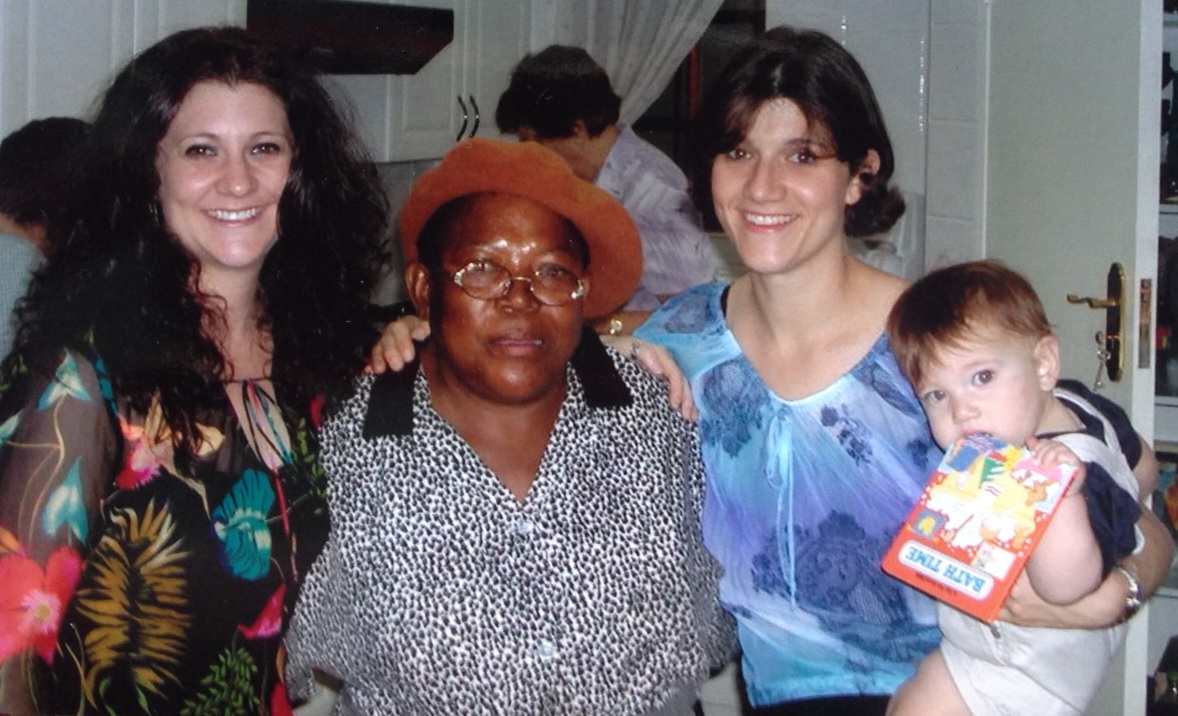
Pretoria, 2002 - My sister, Sina, me and baby Daniel...  and Granny Mary in the background

Pretoria, 2002 – My sister, Sina, me and baby Daniel… and Granny Mary in the background

That was the last time I saw her. Life happens, and we lost touch.

But all my children know all about her. And Ryan and I often share a “Sina memory.” My sister and I talk about her now and again, and smile thinking about things she said and the way she said them.

And in this strange, very connected world we live in, an email found its way to my father this week, with the news that she passed away a month ago. Her funeral was on my late grandmother’s birthday, which feels significant and I don’t know why.

More emails followed between my mother and her daughter, the last 12 years of her life filled in like a picture quickly and brightly drawn on a blank poster board: a grandmother of five grandchildren, great-grandmother to two. What was clear from that drawing was that she loved us as much as we loved her.

An emotional rainbow of sadness, regret, tenderness, laughter and memories.

Zichrona levracha – may her memory be a blessing,” we say in the Jewish religion, when talking or writing about someone who has passed.

Sina z”l: truly a blessing.

Uh Oh Roll Down the Window

Walter

Um who was that?” I asked, waving my hand in front of my face.

“Not meee.” “Wasn’t me.” “It was you!” “No it wasn’t. It was you, Fart Face!”

“Okay guys, doesn’t matter.” Even though I had asked the question.

Thankfully the breezy mountain air swooshed through the half-open windows and replaced any offensive olfactory evidence with its piney freshness. We all took great gulps – even the offender, whoever that was.

It’s never any of them. Even though it was clearly someone. Nobody heard it, but it definitely happened. Like the empty marshmallow bag lying in the pantry. It’s an extra ten steps to the trash can, where an empty bag should be, but that’s neither here nor there – or rather, it’s here, in plain view. Empty. I distinctly told them: one each. Which means the bag should still be three quarters full.

“Who finished all the marshmallows?” I asked the pantry. Oh, that would be… nobody.

Nobody drew on the car seat with navy blue sharpie. Nobody ate the entire bag of marshmallows. Nobody farted. Nobody cut a hole in her leggings. With scissors.

The evidence is right there, for all to see (or smell). So why don’t any of them own up to it?

I used to do the same thing as a kid. In my mind, it was better to say not me, or I don’t know, than confess to the kiddy crime (not that farting is a crime, but it is viewed as some kind of minor assault). Implicating myself was too awful to contemplate. Why would I admit I had done something less than good? Even though it was plainly obvious that it couldn’t have been anyone but me, I didn’t want to admit to myself I had transgressed in any real or imaginary way, and I would never admit it to anyone else.

But really, the assault is in the question: “Who Did It?” Accusatory. Loaded. Implies wrongdoing. Superficially it appears to be a simple request for information – but why is it important who did it? Does it matter who farted? Or who finished the marshmallows? Maybe a little in that whoever did either of those things has or will have a tummy issue in the works, and it’s nice to be prepared I suppose. But there are other ways to ask, without adding a layer of “You’ve done something wrong, now ‘fess up.”

Like: were those marshmallows so yummy? Or: was something bothering you on your leggings that you wanted to cut off? How about: is it more fun to draw on the car seat than on a piece of paper?

I want to get the most information, honestly and directly – and if there’s even an aura of accusation, natural instinct is to go on the defensive. Evade. Or even lie a little. Nope, wasn’t me!

book

As for the farting – do I really need to know?

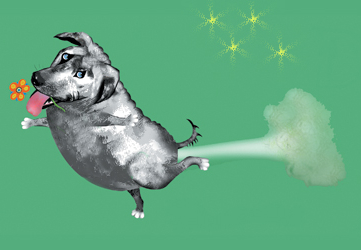
Walter, in one of my favorite children’s books Walter the Farting Dog, has such a bad case of the farts everyone blames him for their own gassiness and he is almost ousted from the house. The book is dedicated to “everyone who’s ever felt misjudged or misunderstood.”

Who cares who it was. Everyone farts.

Better to just roll down the window.

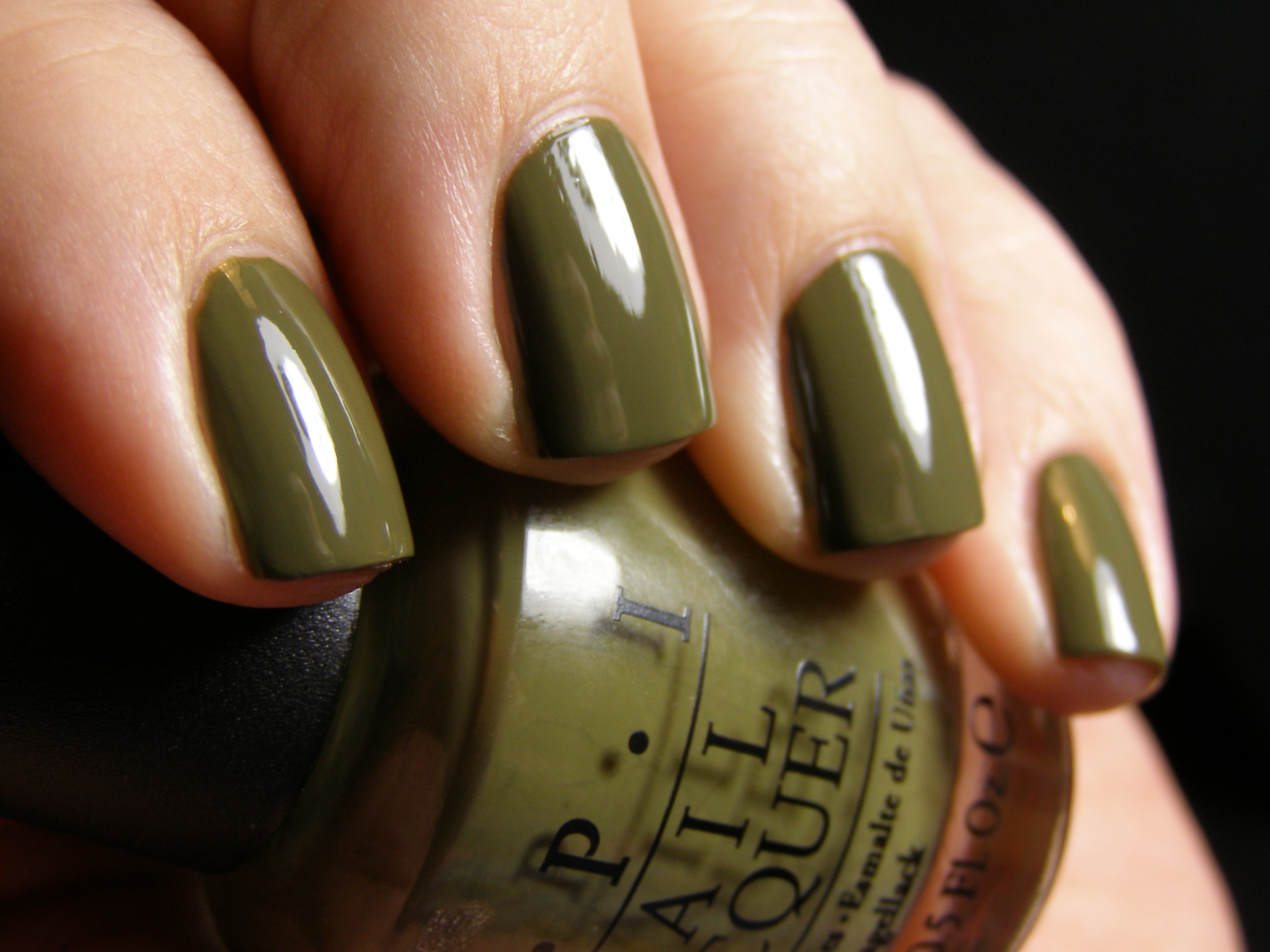
Uh Oh Roll Down the Window by OPI

Uh Oh Roll Down the Window by OPI

This post was written as part of the April A to Z Challenge. To read more of my A to Z posts click here.